

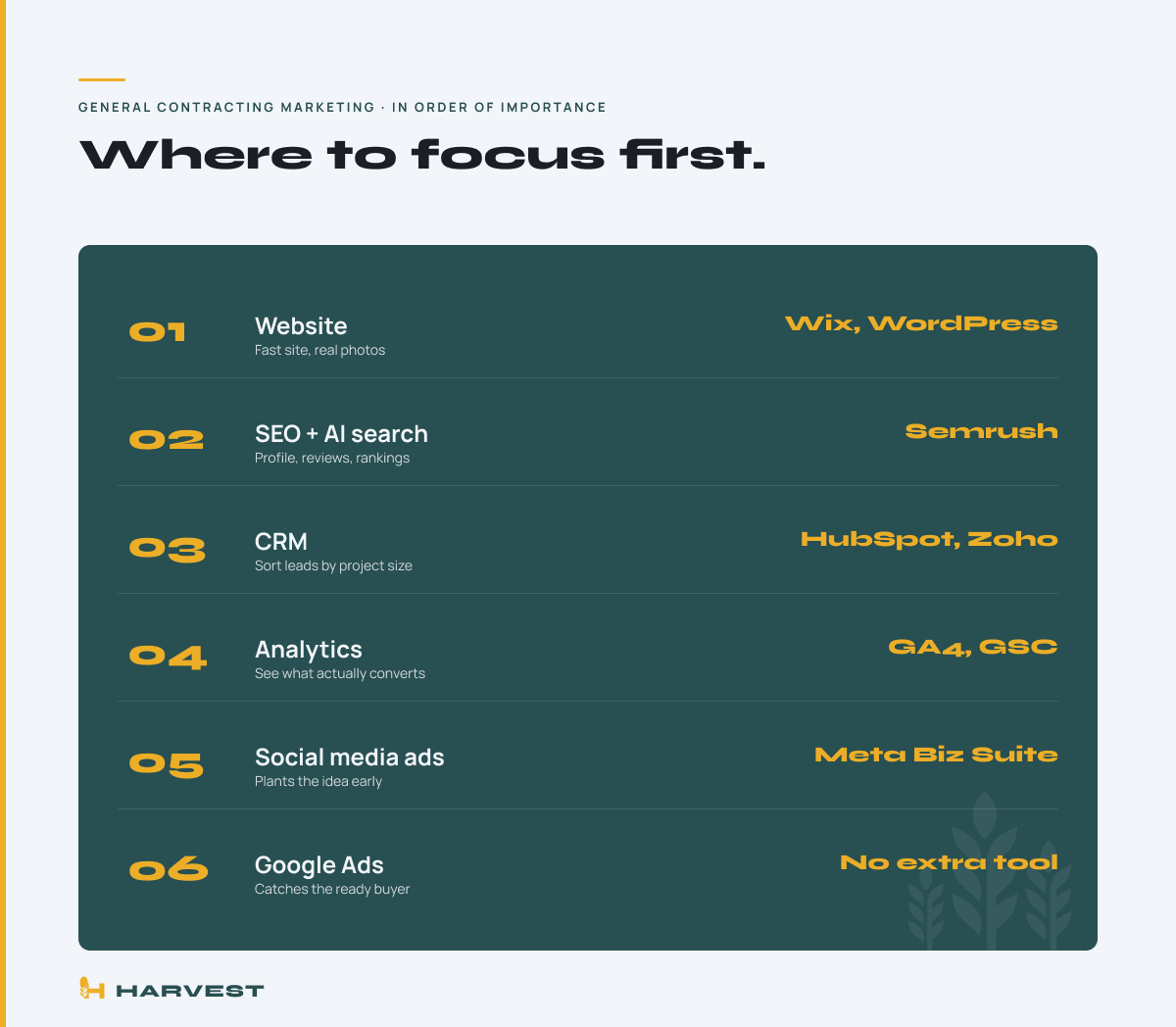
If you are searching for how to market a general contracting business yourself, start with the portfolio, not the phone number. Six things are worth doing, and this trade flips one pair from the order that works for an emergency trade like plumbing or roofing. Website, then getting found on Google, then a system for tracking leads, then checking what is working, then Facebook and Instagram ads, then Google Ads last instead of first.
A design build or general contracting job is a slow, considered purchase. Nobody wakes up needing a kitchen gutted to the studs the way they need a burst pipe fixed.
That changes which channel earns the first dollar, and it starts with a number worth sitting with.
What this post covers
- What 29 local design build sites score on Google’s speed test
- Why photos, not phone numbers, close a remodel
- How many reviews it takes to be a real option in Bucks County
- Why your lead list has to sort by project size, not urgency
- How to read your traffic on a sales cycle measured in months
- Why Facebook and Instagram ads plant the idea before Google Ads ever catches the search
1. Website
On 16 September 2026 we ran Google’s free speed test on the websites of 29 established design build and general contracting companies around Bucks County. The middle score was 52 out of 100.
Only one site broke 90, which is the score Google calls good. That was a lumber and building supply site, not a custom builder.
Loading time is the number that costs jobs. Google says a page should show up in 2.5 seconds. Of the 29 sites, 28 took longer than that, and the middle one took 8.8 seconds.
For most of these builders, the problem is not code. It is photos. A gallery of ten full size project shots straight off a phone camera is several megabytes each, and that is why a portfolio page can take twenty seconds to show a single kitchen.
A homeowner who has been burned by a contractor before is judging your finished work through that gallery. If it will not load, they never see the work that would have won the bid.
Fixing it does not require a rebuild. Compress every photo before it goes on the site, keep the gallery to your best dozen projects instead of every job you have ever done, and make your PA home improvement contractor registration and insurance easy to find on the page.
Wix and WordPress both handle a portfolio site like this without a developer. Wix has a cleaner built in gallery for project photos. WordPress does more once you learn it, and it is where most of the slow sites in this sample live.
2. Getting found on Google
Reviews are the trust signal here even more than in an emergency trade, because the check is bigger and the homeowner has more time to look.
We looked at 64 design build and general contracting companies listed around Doylestown, Newtown, Warminster, Chalfont and Perkasie. The middle company had 21 reviews, and 34 of them, more than half, were under 25.
Only 6 had passed 100. That gap is wide open. In an emergency trade, most established players clear that mark. Here, most have not, which means real review volume is a genuine edge instead of table stakes.
Ask at the final walkthrough, when the client is standing in the finished space and the punch list is done. That is the best moment you will ever get, and it does not repeat.
The rest is upkeep that helps you show up both in Google’s local map results and in the AI answers homeowners now get instead of a list of search results, because both read the same things. A fully filled out Google Business Profile (your free Google listing), a real service area instead of every county in the region, current hours, and photos that match what is on the website.
Semrush is a free tool that shows which remodeling and addition searches you already show up for and which ones a competitor down the road has quietly taken.
3. A simple system for tracking leads
In this trade, a good system for tracking leads sorts them by project size and how close they are to deciding, not by who called first. That is the opposite of an emergency trade, where the loudest call wins.
A homeowner planning a $150,000 addition and one planning a $15,000 bathroom refresh need completely different follow up, and mixing them into one undifferentiated list is how the bigger job goes cold while you chase the smaller one.
Log every consultation the day it happens, note the project size and the homeowner’s timeline, and set a real callback date. A design build sale often takes months of check ins before a signature, and the contractor who checks in on schedule is the one still in the running when the homeowner finally decides.
A tool like HubSpot or Zoho CRM does this for you for free. Both let you tag leads by project size and sort your week around the biggest ones first.
4. Checking what is actually working
Your traffic numbers are steadier here than in a storm driven trade, which makes them more useful, not less. There is no weather event to explain away a bad month.
You need three answers, and they matter more given how long this sale takes. Which project pages people spend real time on, how many of those visits turn into a consultation request, and which searches already bring you traffic before you pay for more of the same.
Watch how long people stay on your portfolio page specifically. A short visit usually means the photos did not load in time to hold anyone.
Google Analytics and Search Console are two free tools from Google. Analytics shows you what people do on your site, and Search Console shows you what people typed into Google to find you. Together they cover all three questions above. Check monthly here, not weekly. This sale moves slowly enough that a week of data rarely tells you anything.
5. Facebook and Instagram ads
Facebook and Instagram ads earn the first dollar in this trade, which flips the order from an emergency trade like plumbing or roofing. Nobody scrolling Instagram is mid crisis. They are picturing what their house could look like.
A single strong before and after photo, or a short walkthrough video of a finished kitchen or addition, plants the idea that becomes a project six months later. This is the moment general contracting has that an emergency trade does not: the sale can start as inspiration instead of a search.
Post real finished projects consistently for free first, before spending a dollar to put any one post in front of more people (that is what “boosting” means). The free post proves the work is real, and the paid boost just gets it in front of more of the right people.
Meta Business Suite is the free tool from Facebook itself, and it runs both your free Facebook and Instagram posts and your paid ads from one place.
6. Google Ads
Google Ads comes last in this trade, not first, because most searches for a general contractor happen after someone has already decided to build, not while they are still forming the idea.
Once your site loads fast and your portfolio actually shows the work, Google Ads catches the homeowner who has already decided and is now comparing three or four names by search.
This is the one step on this list where you do not need another tool. It runs entirely inside Google, and anyone selling you a layer on top of it is adding cost, not consultations.
Bid on the specific project types you actually want. “Kitchen remodel contractor” and “home addition contractor” pull a different, more qualified searcher than the generic “general contractor” term, and judge results on consultations booked, not clicks, because a slow portfolio page wastes every click you buy.
What this actually costs you
A slow portfolio page and a thin review count are not a minor inconvenience in this trade. They are the two things a homeowner checks before they ever pick up the phone to compare bids.
If your site takes 8 or more seconds to show a kitchen photo, and you are sitting on 20 reviews against a competitor’s 60, you are losing the comparison before you are invited to give a number. That is not a marketing problem you can spend your way past. It shows up as fewer consultations for the same amount of word of mouth you have always gotten.
What to do this week
Six things, one per channel, in the order this trade actually sells.
- Search “Google PageSpeed Insights,” put your own address in, and run it on mobile. Around 52 means you are average for this county, and average here is still losing the comparison. Compress your project photos before the next upload.
- Count your Google reviews. Under 25, and more than half the companies in this county are, ask your next three clients at the final walkthrough.
- Open a free HubSpot or Zoho account and tag your open consultations by project size, biggest first.
- Check that Analytics and Search Console are installed, then look at which project pages actually hold a visitor’s attention.
- Post one real finished project this week, before and after if you have it, and let it sit organic for a few days before you consider boosting it.
- Start with the specific project types in Google Ads, not the generic “general contractor” term, once your site and gallery are fast.
That is a lot to run between job sites, especially with a portfolio that needs real editing, not just posting. If it needs a team instead of a few nights this month, see where you’re losing leads for a plain read on what is and is not working, or see how general contractors market with Harvest.

Frequently asked questions
How fast do most general contractor websites load on a phone?
Slower than the portfolio photos deserve. We ran Google’s free speed test on 29 established Bucks County design build and general contracting companies on 16 September 2026. The middle score was 52 out of 100, only one broke the 90 that Google calls good, and 28 of the 29 took longer than Google’s 2.5 second target to show their page. The middle one took 8.8 seconds.
How many Google reviews does a general contractor need to compete in Bucks County?
More than half of them have. Across 64 design build and general contracting companies listed around Doylestown, Newtown, Warminster, Chalfont and Perkasie, the middle company had 21 reviews and 34 of them, more than half, were under 25. Only 6 were past 100.
Why does the portfolio matter more here than in other trades?
Because nobody hires a builder for a whole kitchen or a second floor addition off one phone call. A homeowner comparing three or four builders over months is judging your finished work before your price, and a slow gallery page loses that comparison before your bid is even read.
Should a general contractor run Google Ads or Meta Ads first?
Meta Ads first, which is the opposite order from an emergency trade. A kitchen remodel or an addition starts as an idea somebody is not typing into Google yet. A photo of a real finished project plants that idea. Google Ads picks up the homeowner once they are close to hiring and actually searching. Book a free 15 minute strategy call to talk through the order for your business.
What is the single biggest website mistake general contractors make?
Full size phone photos straight off a job site camera. A gallery of ten uncompressed project photos is most of why these sites load in 8 to 20 seconds on a phone. Compressing them before upload fixes the biggest number on this list without touching anything else.
A middle score of 52 and an 8.8 second load time is not a market somebody has already won. It is a market where the portfolio nobody bothered to compress is quietly losing bids.
That means the general contractor who fixes their gallery, builds real review volume, and sorts leads by project size wins jobs the slow competitor down the road never even gets invited to bid on. If you would rather have the local SEO and web design side handled for you, along with Google Ads and Meta Ads, contact Harvest Digital Marketing for a plain look at what makes sense next.